
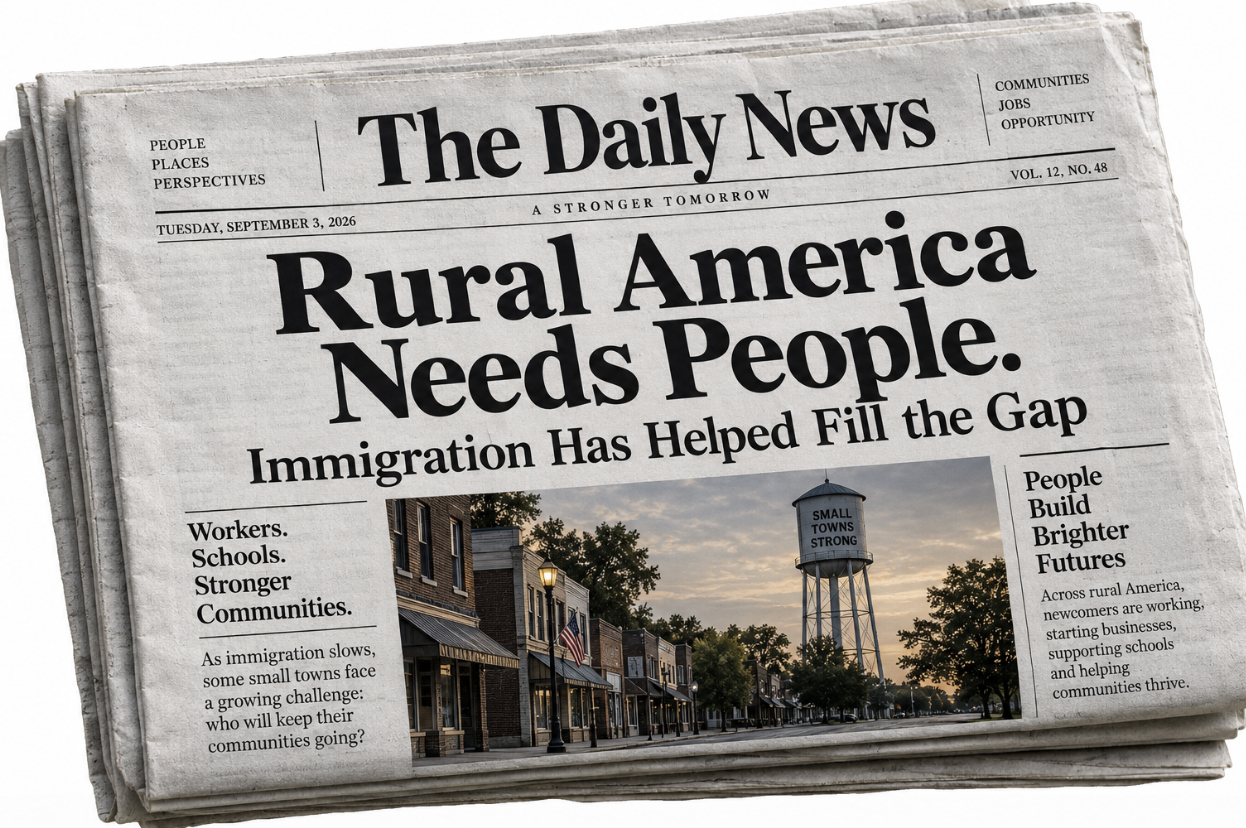
Immigration coverage often begins at the border.
But some of the consequences of changing immigration patterns are unfolding hundreds of miles away — in small towns where newcomers have become workers, business owners, students, caregivers and neighbors.
That was the focus of a recent American Community Media briefing that challenged journalists to look beyond national political battles and examine immigration through the communities experiencing its effects firsthand.
Louisiana State University sociology professor Tim Slack described immigration as a “population lifeline” for many rural communities.
Federal data provide context. After a decade of population loss, nonmetropolitan America began growing again after 2020. Migration drove that rebound, offsetting losses from deaths exceeding births. International migration accounted for 48% of net migration gains in nonmetro counties between 2023 and 2024, according to the U.S. Department of Agriculture.
Yet the picture of rural America presented in news coverage can be narrower than the communities themselves.
Slack told reporters that roughly one in four rural residents is nonwhite and about one in three rural children is nonwhite.
“The future of rural America’s increasingly diverse,” he said, “even if popular images don’t always show it.”
The briefing also put local experiences behind the numbers.
Former Storm Lake, Iowa, police chief Mark Prosser described immigration as part of a decades-long transformation of his community as immigrant workers and families settled there.
In Springfield, Ohio, the Rev. Carl Ruby said Haitian immigrants have opened businesses, helped employers fill jobs and worked in retirement homes where workers had been difficult to find.
Rachel Perić, executive director of Welcoming America, urged journalists to pay attention not only to federal policy but also to what is happening inside communities as immigration enforcement and uncertainty affect relationships among neighbors, employers, schools and local institutions.
That local reporting may become increasingly important. The Census Bureau estimates net international migration fell from 2.7 million in 2024 to 1.3 million in 2025.
For journalists, the numbers tell only part of the story.
The other part is happening in classrooms, workplaces, churches, nursing homes and on Main Streets — places that rarely become the backdrop for the national immigration debate.
Covering immigration beyond the border may also mean taking a closer look at who rural America really is.