
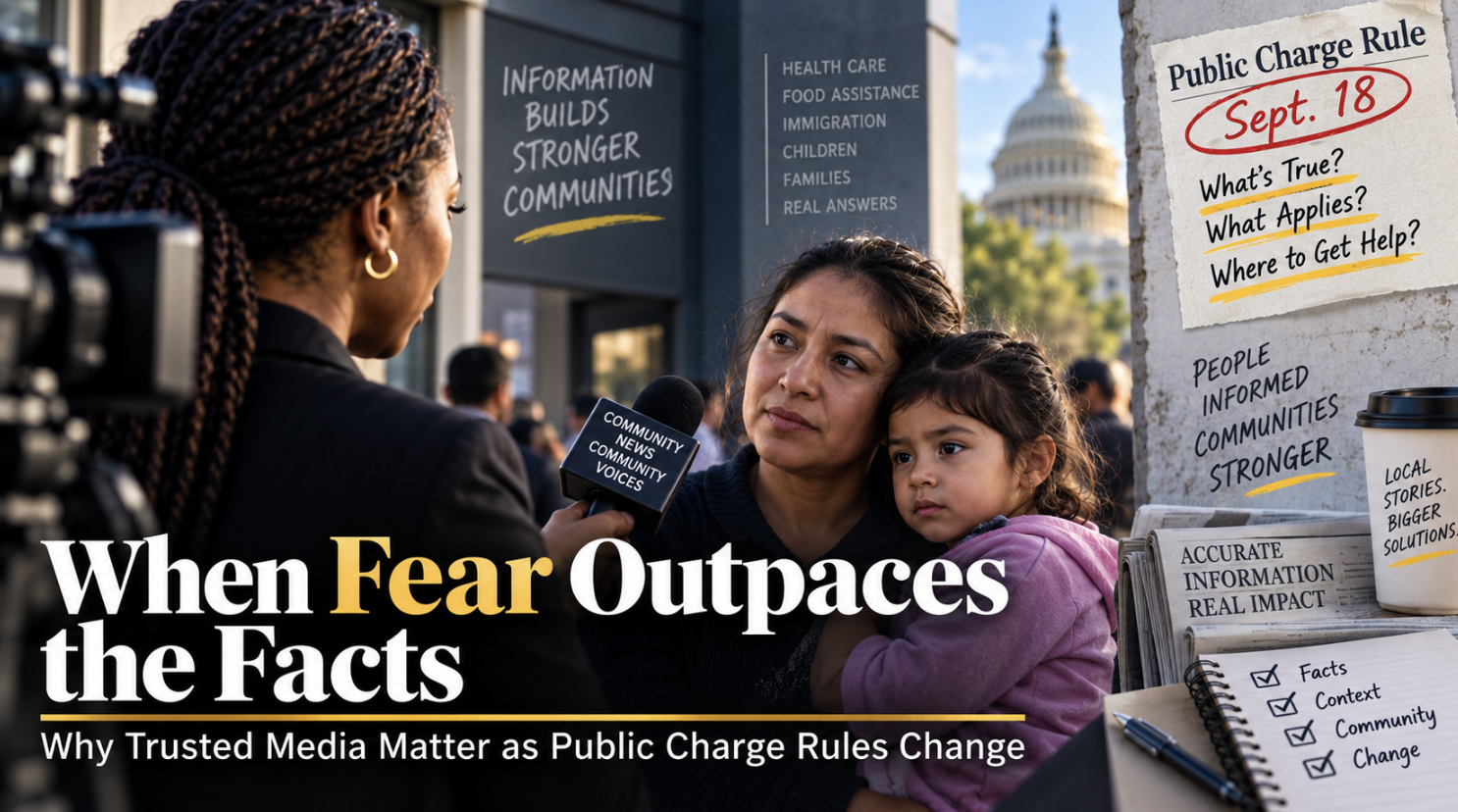
As a broader federal public charge policy approaches its Sept. 18 effective date, immigration and public health experts are warning that its impact may extend far beyond the people directly affected by the rule.
The reason is fear.
During an Aug. 7 American Community Media national news briefing, experts said confusion surrounding immigration policy is already influencing whether some families seek health care, food assistance and other benefits for which they or their children may be eligible.
“The fear is bigger than the rule,” said Xiao Wang, CEO and co-founder of Boundless Immigration.
That distinction presents an important challenge for journalists and other trusted community messengers: explaining not only what a changing federal policy does, but also what it does not do.
The Trump administration’s expanded public charge standard is scheduled to take effect Sept. 18. It gives immigration officials broader discretion when determining whether certain green-card applicants may become dependent on public assistance.
But the policy does not apply to every immigrant, every benefit or every member of an immigrant household.
And according to experts at the briefing, misunderstanding those distinctions can carry serious consequences.
When fear changes behavior
Wang pointed to research following an earlier expansion of public charge that showed one in five adults in immigrant families reported avoiding public benefits because of immigration-related fears. Among low-income immigrant families, the number rose to three in 10.
The chilling effect can reach people who are not directly subject to the public charge test.
Benefits received by family members, including Medicaid or food assistance for U.S.-citizen children, generally are not considered benefits received by the person applying for a green card, Wang explained. Yet families may still stop using those programs because they fear doing so could jeopardize someone’s immigration status.
For journalists covering immigrant communities, that creates an unusually complicated information environment.
Reporting that simply says a public charge rule has been expanded may be accurate but incomplete for an audience trying to determine whether the change affects them personally. Details about who is covered, who is exempt, when the rule takes effect and whose benefits are considered can become as important as the headline itself.
Children caught in the uncertainty
The consequences are particularly significant for children.
Joan Alker, executive director of Georgetown University’s Center for Children and Families, said about one in four U.S. children lives in what she described as a mixed-status family — a U.S.-citizen child living with an immigrant or naturalized parent.
At the same time, enrollment in Medicaid and the Children’s Health Insurance Program, or CHIP, has been falling.
Alker said 2.3 million fewer children were enrolled in Medicaid and CHIP as of June 2026 than in January 2025.
She cautioned against attributing that entire decline to public charge. The new rule has not yet taken effect, and researchers do not know how many children who left the programs became uninsured.
However, Alker said fear among mixed-status families is believed to be one contributing factor to enrollment declines, alongside broader concerns about immigration enforcement and government data sharing.
That nuance matters.
Without it, a dramatic enrollment number can easily become disconnected from what researchers actually know — another reason accurate context is essential when reporting on rapidly changing immigration policies.
Reaching communities requires more than publishing information
The challenge of getting accurate information to families is not new.
During the briefing, a journalist described earlier outreach efforts surrounding CHIP enrollment in Harris and Fort Bend counties in Texas. Reaching Hispanic, Pakistani, Asian and other communities required more than announcing that coverage was available. Outreach included community events and going door-to-door to explain the program to families.
The exchange highlighted a reality familiar to journalists serving historically overlooked communities: information can be publicly available without being truly accessible.
Language, trust, culture and relationships can influence whether information reaches the people who need it — and whether they believe it once it does.
Those challenges become even greater when immigration status is involved.
Dr. Giridhar Mallya, a public health physician and senior policy officer at the Robert Wood Johnson Foundation, said policy changes are already affecting participation in food assistance programs.
SNAP participation declined by 4.5 million people over a nine-month period, including nearly 1.5 million children, according to figures Mallya presented during the briefing.
“Part of the motivation behind all these policies is to create confusion and fear,” Mallya said, adding that immigrants, communities of color and other underserved communities are among those bearing the effects.
What families need to know
One of the clearest pieces of information to emerge from the briefing involves timing.
Wang said green-card applications filed before Sept. 18 will remain subject to the narrower public charge standard currently in place, even if the government decides the case after the new policy takes effect.
He encouraged applicants who are eligible and prepared to file to consider doing so before Sept. 18 and to seek individualized guidance from a qualified immigration attorney or authorized nonprofit immigration service provider.
Experts also stressed that the public charge test does not apply to everyone. Wang identified refugees, asylees, certain trafficking and crime survivors, special immigrant juveniles and some applicants protected under the Violence Against Women Act among categories exempt from public charge considerations. Naturalization applications are also not subject to the public charge test.
For journalists covering the change, those distinctions are not fine print.
They may determine whether a family keeps a child enrolled in health coverage, continues receiving food assistance or walks away from help because of a rule that may not apply to them.