
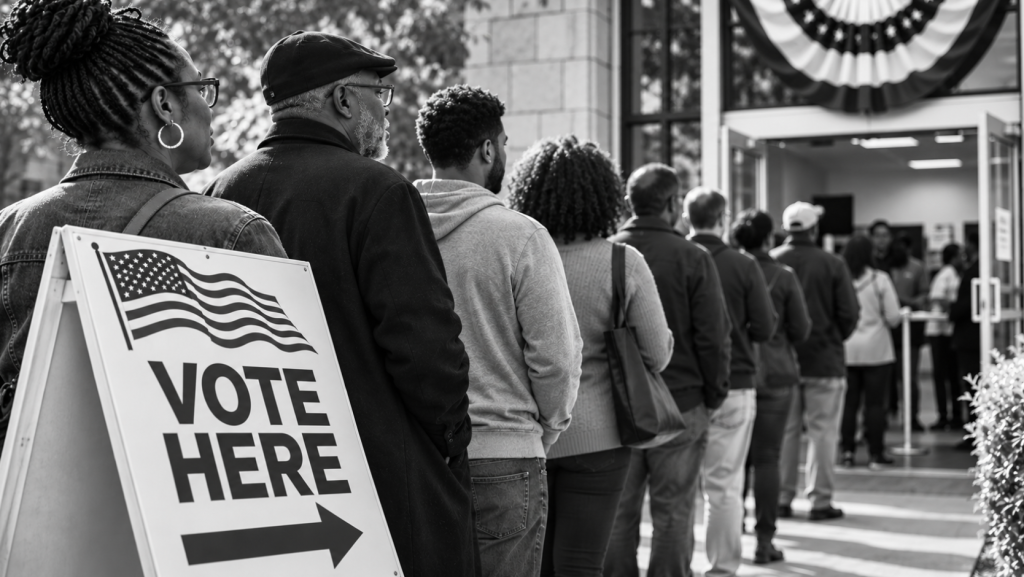
As the Nov. 3 midterm elections approach, journalists serving diverse communities are highlighting the importance of reporting that goes beyond campaign rhetoric, polling numbers and predictions about voter turnout.
During an Oct. 30 national briefing hosted by American Community Media, six journalists discussed the issues shaping political conversations among Black, Latino, Asian American, Native American and Arab American communities.
Their accounts underscored the role of community-based journalism in documenting voters’ concerns, explaining government decisions and providing historical context often missing from broader election coverage.
The discussion also raised important questions for newsrooms: How can journalists accurately represent communities with differing political views? How should reporters distinguish political interest from actual voter participation? And what responsibility do community news organizations have in helping audiences understand the issues affecting their lives?
Reporting beyond election numbers
In Los Angeles, Néstor Fantini, co-editor of Hispanic LA, described affordability and immigration enforcement as major concerns among Latino residents.
Fantini discussed the economic pressures facing families and the uncertainty surrounding immigration policies. But he also cautioned against assuming that political concern automatically produces electoral participation.
In New York, Rong Xiaoqing, a reporter for the Chinese-language Sing Tao Daily, described strong interest in early voting among residents of the Chinese American neighborhoods she covers.
She also noted differences in political opinion within the community, particularly concerning immigration enforcement.
Their observations illustrate an important reporting distinction: Community conversations and visible enthusiasm can provide valuable insights, but they cannot independently establish turnout trends or represent the views of an entire population.
Why historical context matters
For journalists covering Black communities, understanding the historical significance of elections can be as important as reporting on individual candidates.
Edelia Carthan, a contributing writer for The Mississippi Link, discussed how Mississippi’s history of racial discrimination and barriers to Black political representation continues to inform political conversations.
Carthan connected current concerns about redistricting, diversity policies and access to health care with the state’s political history.
She also described the importance of explaining that history to readers.
During the briefing, Carthan said her reporting emphasizes historical context because many residents may be unfamiliar with events and policies that continue to influence public life.
She pointed to the importance of covering city council meetings, state legislative proceedings and school board decisions to help readers understand how government actions affect their communities.
Her comments reinforced the role of local journalism in connecting present-day political debates with the policies and historical developments that shaped them.
Covering communities without oversimplifying them
In Silicon Valley, Vandana Kumar, publisher and CEO of India Currents, discussed how employment uncertainty, immigration policies and the cost of living are affecting some Indian American families.
Kumar also emphasized that political engagement takes different forms.
Some immigrants closely follow public policy but are not eligible to vote. Others are eligible but uncertain whether participating will make a difference.
That distinction is particularly important when journalists report on immigrant communities, where citizenship, residency status and voting eligibility can vary.
Kumar also described the responsibility of ethnic media organizations to explain government decisions without directing audiences toward a particular political position.
“We create spaces where people feel heard,” Kumar said, explaining that community journalists help audiences understand how policies affect them and how they can participate.
Bringing underreported concerns into public view
Lori Ann Edmo, editor of Sho-Ban News in Idaho, discussed the importance of reporting on tribal sovereignty, treaty rights and federal funding decisions affecting Native American communities.
Those subjects require an understanding of the distinct legal relationship between tribal nations and the federal government.
In Dearborn, Michigan, Osama Siblani, publisher of The Arab American News, described concerns about discrimination, political rhetoric and the economic challenges facing Arab American families.
Siblani also emphasized the value of collaboration among community news organizations in sharing reporting and expanding access to information.
Together, their comments highlighted the range of subjects that community journalists cover beyond conventional campaign developments.
The responsibility of community journalism
The briefing offered a reminder that accurate election reporting requires more than identifying which candidates are ahead or which communities might influence an election.
It also requires listening to residents, examining the policies affecting their lives and providing context for political concerns.
For Black journalists and other reporters serving historically underrepresented communities, that work includes documenting the experiences of people whose perspectives may receive limited attention in larger news outlets.
It also demands the same standards of verification, fairness and accurate attribution expected of all professional journalism.
The journalists’ observations during the briefing were based on their reporting experiences and community conversations, not nationally representative surveys. Their accounts provide insight into the issues being discussed locally but do not establish how entire populations will vote.
As Election Day approaches, those distinctions remain essential.
Community journalists have an opportunity to deepen public understanding by reporting not only on electoral outcomes but also on the histories, concerns and government decisions shaping the communities they serve.
Their work helps ensure that election coverage reflects more than political campaigns. It reflects the people affected by the decisions voters are being asked to make.