
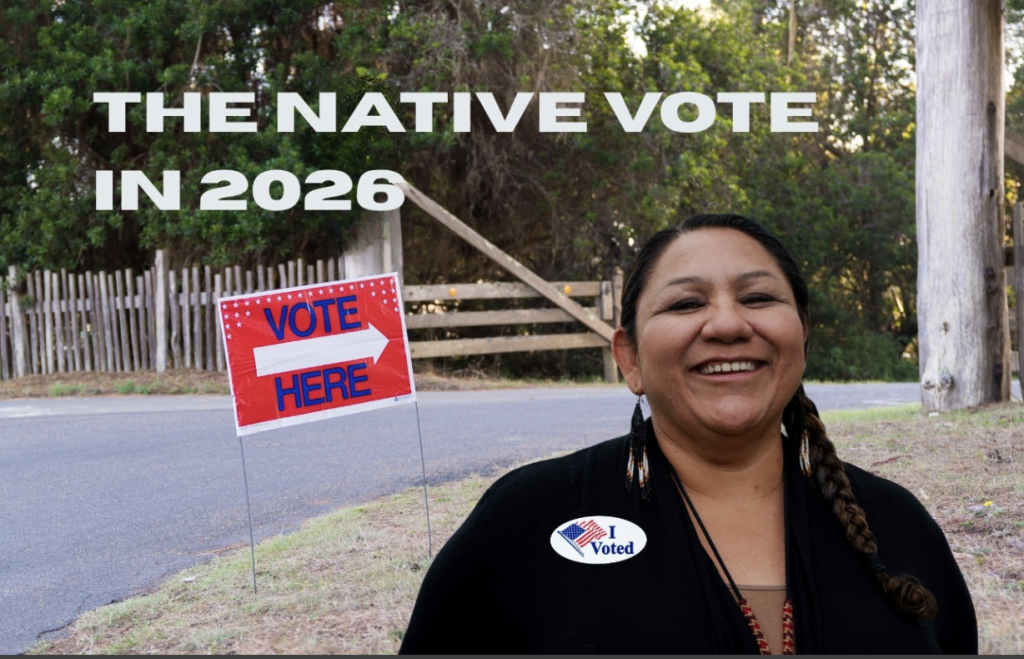
As Americans focus on the 2026 midterm elections, the political priorities and experiences of Native American voters offer an important reminder of why inclusive, informed journalism matters.
Native voters share many of the concerns shaping elections nationwide, including economic security, affordable housing and access to essential services. But their political priorities also reflect the distinct legal, historical and cultural relationships between tribal nations and the United States.
Understanding those differences is essential to accurate election reporting.
That message emerged during an Oct. 9 national briefing hosted by American Community Media, titled The Native Vote in 2026: Sovereignty, Representation and Political Power.
The discussion featured Michael Roberts, president and CEO of First Nations Development Institute; Melissa Rogers, professor of politics and policy at Claremont Graduate University; Judith LeBlanc, executive director of Native Organizers Alliance; and Sage Phillips, co-coordinator of the Wabanaki Policy Youth Initiative.
Together, they offered perspectives on Native political participation, the challenges some voters encounter and the importance of understanding Indigenous communities beyond election statistics.
Native voters are not a monolith
One of the briefing’s central themes was the diversity of Native American communities.
Roberts cautioned against treating Native voters as a uniform political bloc or assuming their concerns can be defined solely by party affiliation.
Native communities differ in geography, culture, language, government and political experience. The priorities of voters living on tribal lands may overlap with those of Native Americans living in cities, but their experiences accessing government services and participating in elections can differ.
Roberts said research conducted by his organization during the 2024 election cycle found that Native voters shared concerns about inflation, housing and economic opportunity with the broader electorate.
At the same time, tribal sovereignty, cultural preservation, Native languages and ancestral lands remained important priorities.
His observations highlighted the importance of recognizing Native communities as distinct populations with their own histories, governments and perspectives rather than treating them as a single demographic category.
Voting access deserves closer examination
Melissa Rogers, a professor at Claremont Graduate University, discussed research examining the barriers some Native American voters encounter when attempting to participate in elections.
Those challenges include long distances to polling locations, limited postal services, difficulties with voter registration and identification requirements involving nontraditional residential addresses.
Rogers explained that these barriers can be particularly significant in rural communities and on tribal lands.
She also noted that Native voters living in urban areas may encounter different challenges, including limited polling locations, long lines and transportation difficulties.
Her research illustrates an important distinction: Legal eligibility to vote does not necessarily mean voting is equally accessible.
Understanding where polling places are located, how election procedures affect different communities and whether residents can reasonably access voting services provides valuable context for election coverage.
Those circumstances vary by location and state law, making community-specific reporting particularly important.
Sovereignty is essential context
Judith LeBlanc, executive director of Native Organizers Alliance and a citizen of the Caddo Tribe of Oklahoma, emphasized the importance of tribal sovereignty in understanding Native American political concerns.
Federally recognized tribal nations have a distinct political and legal relationship with the United States. Their sovereignty and treaty rights are not simply cultural interests; they are central to questions involving governance, land, resources and federal responsibilities.
LeBlanc discussed how Native communities continue to advocate for housing, education, economic development and essential services while protecting their rights and political standing.
She also highlighted the importance of Native representation in local government, particularly for Indigenous people living in urban communities.
“Representation is not the destination. That’s not going to solve our problems, but what it does do is give voice to the solution,” LeBlanc said.
Her comments reflected the broader significance of political representation and the role elected officials can play in addressing community priorities.
A younger generation is shaping the conversation
Sage Phillips, co-coordinator of the Wabanaki Policy Youth Initiative in Maine, described efforts to introduce young people to legislative advocacy, public policy and civic engagement.
The initiative has helped young Wabanaki and non-Wabanaki participants learn about tribal rights, engage with elected officials and share information with their communities.
Phillips discussed young organizers traveling throughout Maine, registering voters, speaking with candidates and helping residents understand issues affecting Wabanaki nations.
Their advocacy includes concerns involving the 1980 Maine Indian Land Claims Settlement Act and the implementation of Wabanaki studies requirements in schools.
The initiative illustrates how younger generations are contributing to ongoing discussions about tribal rights, political representation and public policy.
It also highlights the historical context behind legislation that continues to affect Native communities decades after its passage.
The importance of informed, community-centered journalism
The briefing also raised broader questions about how Native American communities are represented in political reporting.
Election coverage frequently concentrates on national candidates, campaign strategies and predictions about which voting blocs may determine an outcome.
Those stories have value, but they do not necessarily capture the full range of issues affecting Native communities.
Coverage examining tribal governments, treaty obligations, voting access, local representation and community-led organizing can provide audiences with a more complete understanding of Native political participation.
The Indigenous Journalists Association, a professional organization supporting Indigenous journalists and accurate coverage of Indigenous communities, has long emphasized the importance of informed reporting, appropriate terminology and understanding tribal sovereignty.
Its work offers valuable resources for newsrooms seeking to strengthen coverage of Native Nations and Indigenous peoples.
For journalists, including those serving historically underrepresented communities, the discussion reinforces the value of listening directly to tribal leaders, Native journalists, community organizations and residents.
It also underscores the importance of recognizing that Indigenous communities are not interchangeable and that tribal sovereignty, identity and history require thoughtful attention.
The Oct. 9 discussion offered a perspective that remains relevant beyond the midterm elections.
The Native vote is more than an election statistic. It represents communities with distinct histories, governments, rights and aspirations whose voices deserve accurate, informed and sustained coverage.