
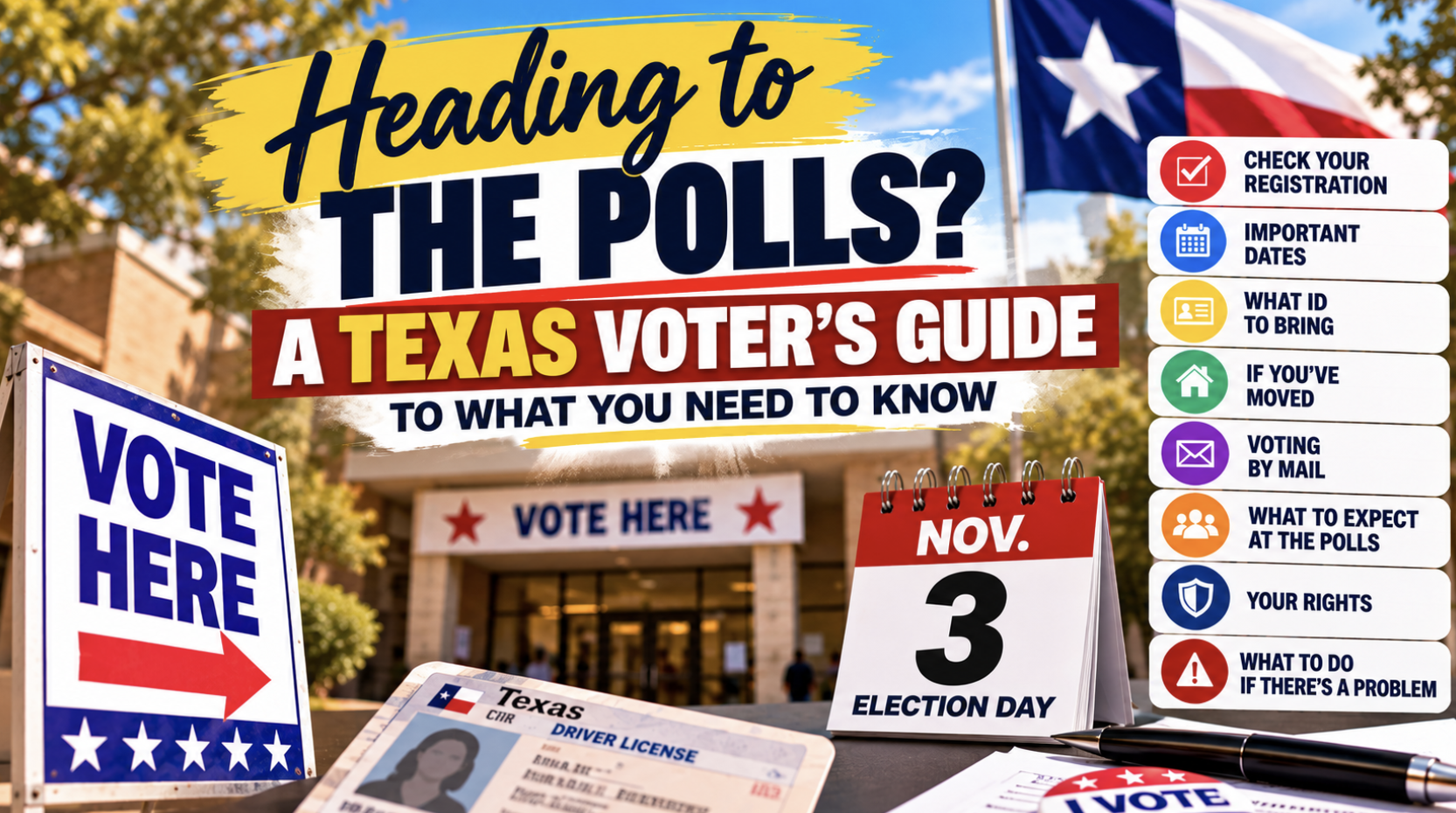
Texas voters preparing for the Nov. 3 general election may encounter unfamiliar terms, questions about identification, changes in polling locations or even problems with their voter-registration records.
Guidance shared by the Texas Civil Rights Project, a nonpartisan nonprofit that conducts election-protection work across the state, offers a useful starting point for understanding what voters should look for before and when they head to the polls. The information below also reflects current guidance from the Texas Secretary of State for the 2026 general election.
Here’s what Texas voters need to know.
1. Check your registration — even if you think everything is fine
Texas’ deadline to register for the Nov. 3 election was Oct. 5, but registered voters can still check their status and make sure the information on their voter record is correct.
This can be especially important for anyone who has recently moved or received election mail indicating there may be an issue with their address.
Texas voters can check their registration through the state’s official voter lookup. Check your Texas voter registration Democracy Works
If your record says “Suspense,” don’t assume that means you cannot vote.
A suspense designation generally means election officials need confirmation of your current residential address. A voter who still lives at the registered address, or who moved within the same county, may be able to complete a Statement of Residence and vote. Democracy Works
2. Know the dates
Early voting begins Monday, Oct. 19, and continues through Friday, Oct. 30.
Election Day is Tuesday, Nov. 3, when Texas polls are open from 7 a.m. to 7 p.m. Texas Secretary of State
Don’t assume your early-voting location is the same place you would vote on Election Day. Check the location and hours before leaving home. Democracy Works
3. Bring an acceptable photo ID — but know your options if you don’t have one
Texas voters are asked to present one of seven acceptable forms of photo identification: a Texas driver’s license, Texas Election Identification Certificate, Texas personal identification card, Texas handgun license, U.S. military identification card with a photograph, U.S. citizenship certificate with a photograph, or U.S. passport book or card. Democracy Works
For most voters, the ID can be expired by up to four years. For voters age 70 or older, an otherwise acceptable ID may be expired for any length of time. Democracy Works
And not having one of those seven photo IDs does not automatically mean you cannot vote.
A voter who has a reasonable impediment to obtaining one of the accepted photo IDs may sign a Reasonable Impediment Declaration and present supporting identification, such as a valid voter-registration certificate, certified birth certificate, current utility bill, bank statement, government check, paycheck or another qualifying government document. Democracy Works
4. If you’ve moved, where you moved matters
Moving within your county and moving to another Texas county are handled differently.
If you moved within the same county but did not update your registration before the deadline, you may complete a Statement of Residence and vote using the applicable procedures.
If you moved to another county and aren’t registered there in time for Election Day, you may qualify for a limited ballot.
But there’s an important catch: an eligible voter can cast a limited ballot only during early voting, Oct. 19–30, and an in-person limited ballot must be cast at the main early-voting location. The ballot includes statewide races and district offices shared by the voter’s former and new counties. Texas Secretary of State
5. If you’re voting by mail, pay attention to the details
The deadline for an early-voting clerk to receive — not simply have postmarked — an application for a ballot by mail is Oct. 23. Texas Secretary of State
Texas limits mail voting to voters who meet state eligibility requirements.
For completed mail ballots, deadlines depend partly on the postmark. A domestic ballot without a qualifying postmark generally must arrive by 7 p.m. on Election Day. A ballot properly postmarked by 7 p.m. on Election Day can generally arrive by 5 p.m. Nov. 4. Different deadlines can apply to certain military and overseas voters. Texas Secretary of State
Voters should carefully follow the identification-number instructions on the mail-ballot carrier envelope. Democracy Works
6. Know who’s who at the polls
Not everyone you see around a polling location has the same role.
Poll workers administer the election. Poll watchers are appointed under Texas law to observe election activities on behalf of authorized candidates, political parties or other eligible entities.
Nonpartisan election-protection volunteers may also be outside polling locations helping voters understand their rights or directing them to assistance.
Knowing the difference can help voters understand who has official authority inside the polling place and who does not.
7. Don’t let something you see online be your only source
Election misinformation can spread quickly, particularly when a social-media post claims that a polling location has closed, voting hours have changed or certain voters cannot cast ballots.
The Texas Civil Rights Project recommends checking questionable information against authoritative sources rather than simply repeating or sharing it.
That is especially important when the information could discourage someone from voting.
If a post says your polling location has changed, for example, verify it with an official election source before changing your plans.
8. If there’s a problem, ask for help
If your name isn’t on the voter list, your registration status appears incorrect or another problem arises, don’t simply leave the polling place without asking what options are available.
Depending on the circumstances, a voter may be able to correct an address, complete additional paperwork or cast a provisional ballot.
Texas voters who cast certain provisional ballots because of an identification issue may have additional steps to complete after Election Day for that ballot to be counted. Democracy Works
The Texas Civil Rights Project also participates in the nonpartisan Texas Election Protection Coalition, which connects voters with trained assistance when election problems arise.
The bottom line
Voting shouldn’t begin with walking through the polling-place door.
Before leaving home, check your registration, confirm your voting location and hours, know what identification you plan to use and understand your options if something doesn’t look right.
And if you encounter a problem, ask questions before walking away.
For official Texas voting information, voters can visit VoteTexas.gov.