
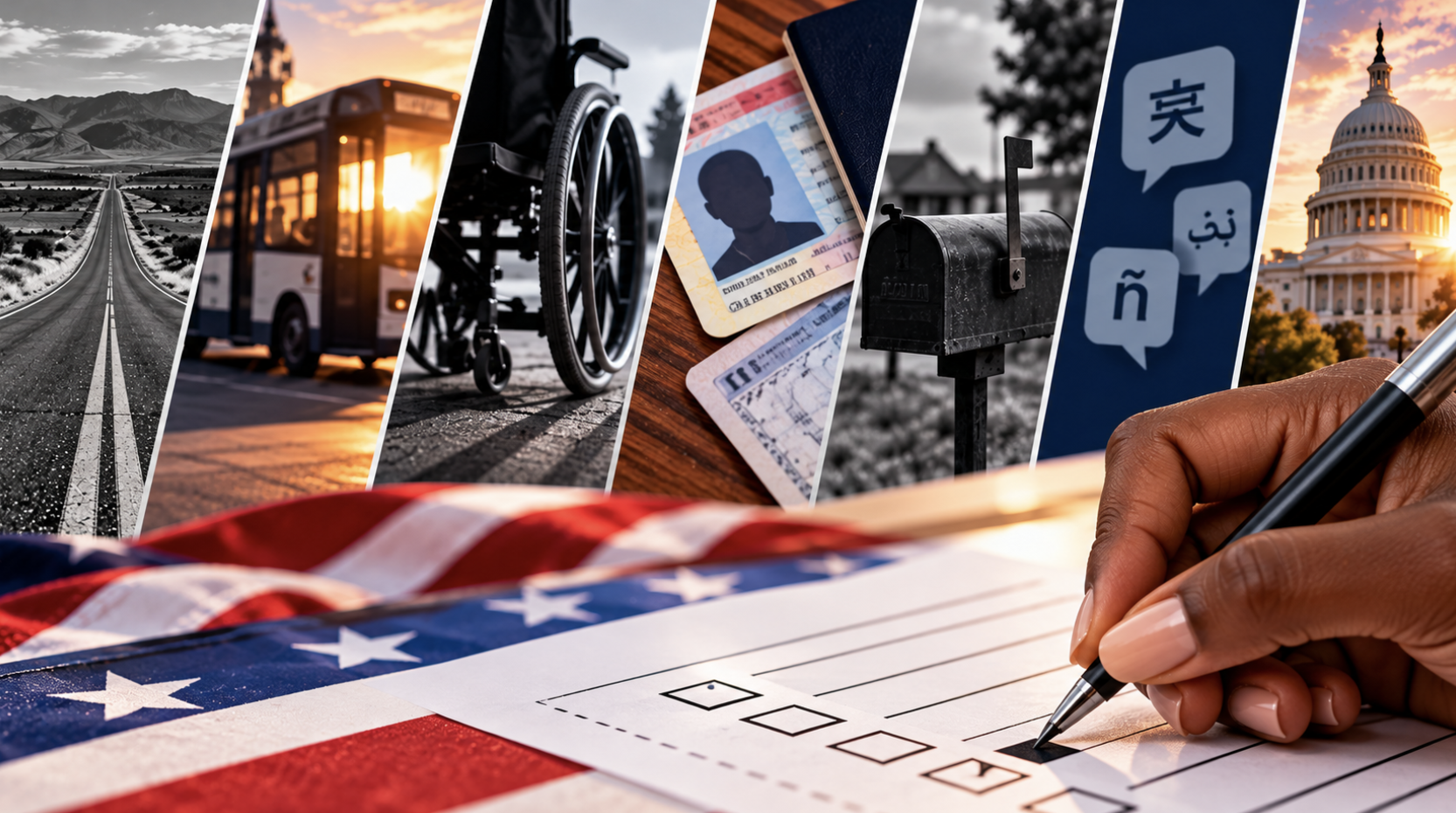
With the Nov. 3 midterm election approaching, voting advocates say Americans across the country are navigating a patchwork of barriers that can make casting a ballot more complicated depending on where they live.
Voter identification requirements, transportation, distance to polling locations, language access, mail-ballot restrictions and changing election procedures were among the concerns raised during a recent American Community Media briefing examining voting access for ethnic communities.
The challenges vary widely by state and community.
In Georgia, Monica Spencer, state director for VoteRiders, said her organization helps voters obtain identification and the underlying documents sometimes needed to get it, including birth and marriage certificates. The organization also assists with transportation when necessary.
Spencer said the process can be particularly difficult for rural residents without public transportation, elderly voters navigating ID renewals and people who no longer have documents needed to establish their identity.
“People really don’t know what to take to the ballot,” Spencer said while discussing confusion surrounding voter-ID requirements.
For some Native American voters, the barrier can be distance.
Jacqueline De León, senior attorney with the Native American Rights Fund, said some Native voters must travel from 20 to 100 miles to reach voting or registration opportunities. Some reservation residents also lack traditional residential addresses and home mail delivery, which can complicate voter registration and voting by mail.
NARF plans to send roughly 300 poll watchers into rural Native communities during the upcoming election to document problems and report them to attorneys when intervention may be necessary.
In Texas, Jesus Zamora, field director for Mi Familia Vota, pointed to another set of obstacles.
Texas does not have a fully online voter-registration process. Zamora said his organization’s canvassers also encounter residents without reliable transportation who may face lengthy walks to reach polling locations. His organization operates in several areas of Texas, with its main operation in Houston and Harris County.
Changing political districts have created additional confusion, Zamora said, prompting organizers to use door-to-door canvassing, text messages and social media to help voters find reliable information about their districts and representatives.
John C. Yang, president and executive director of Asian Americans Advancing Justice | AAJC, focused on another concern: fear and misinformation.
Yang said reports suggesting ICE agents would appear at polling locations remained rumors at the time of the briefing, and he urged voters not to allow unverified information to discourage them from participating. He also reminded reporters that voters may have language-assistance rights and that speaking, reading or writing English is not a general prerequisite for casting a ballot.
“Don’t let the misinformation dissuade you from voting,” Yang said.
Despite the different circumstances described by the speakers, their practical advice was largely the same: prepare before Election Day.
Voters should check their registration status, learn the identification requirements in their state, verify their polling location and review their ballot before heading to the polls.
“Please make sure you check your voter registration status and your ID,” Spencer said. “As you’re doing that, check your precinct location as well as your sample ballot.”
The briefing’s larger takeaway was straightforward: there is no single barrier to voting — and no single set of voting rules that applies everywhere.
For voters heading into November, knowing the rules where they live may be one of the most important preparations they make.