
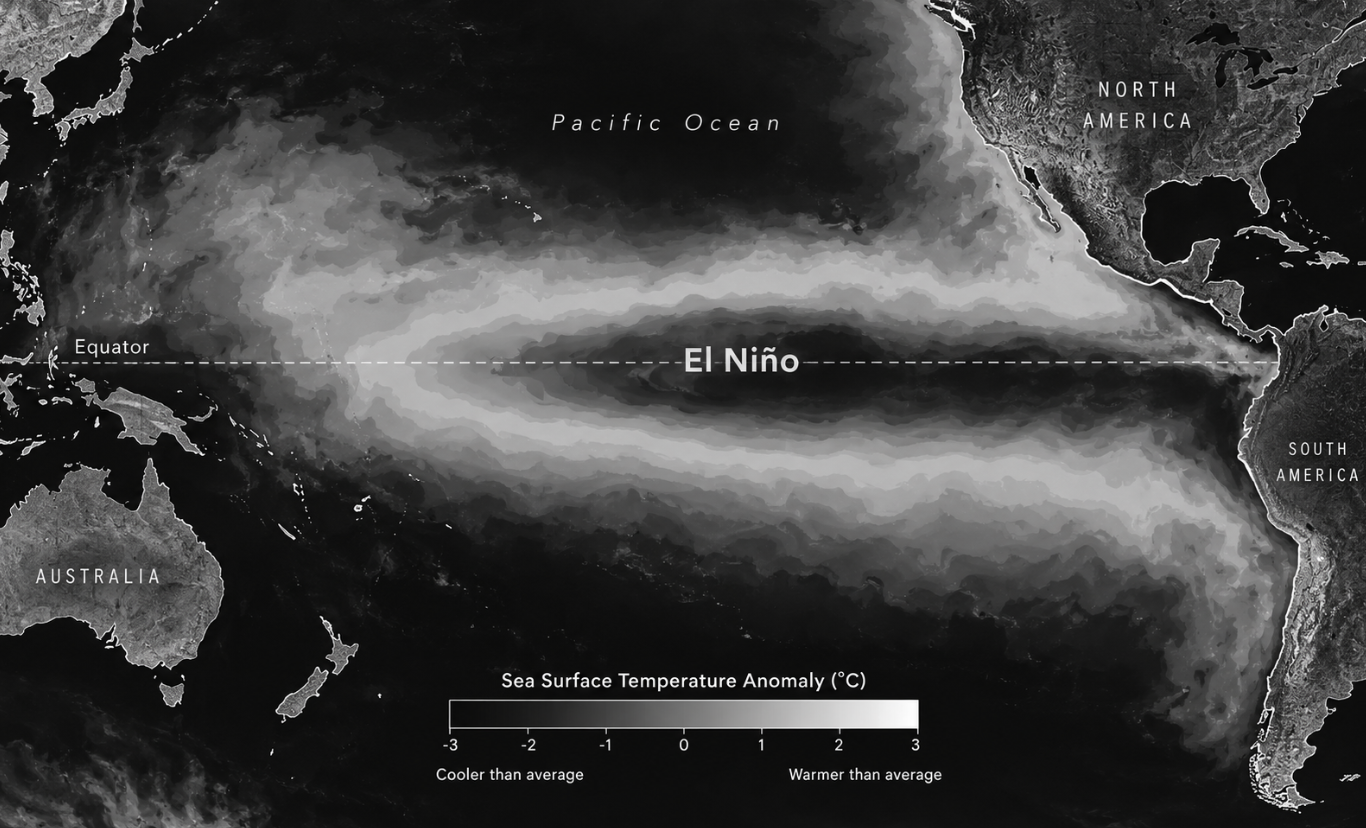
A potentially record-breaking El Niño is strengthening in the Pacific, and climate scientist Daniel Swain has a message for journalists covering it: the story is serious enough without making it scarier than the science supports.
Forecasting models indicate the current El Niño could become the strongest on record, affecting weather patterns across the United States and around the world into 2027.
But as dramatic warnings spread online, Swain cautioned that exaggerating the threat can make it harder for audiences to understand the risks that are real.
“The headlines run wild,” Swain said during an American Community Media national news briefing.
For journalists, his warning raises a familiar challenge: How do you communicate serious risk without creating unnecessary fear?
The science is dramatic enough
There is no need to manufacture urgency.
Temperatures in a key region of the eastern tropical Pacific were already exceeding historical levels for that time of year, Swain said, while forecasting models showed the event strengthening further and potentially surpassing the previous record.
Even the terminology requires care.
“Super El Niño,” increasingly used to describe the developing event, is not an official scientific classification.
“There is no formal definition of a super El Niño,” Swain said.
Still, he made clear that the forecast itself is extraordinary.
“I would suggest maybe we need a new category of extreme El Niño, because the forecast for this year is genuinely extreme,” Swain said.
That’s the balance: don’t minimize what scientists are seeing, but don’t turn possibility into certainty.
When exaggeration backfires
Swain described a cycle familiar to anyone working in a modern newsroom.
Claims begin circulating online. News organizations pick them up. Headlines become increasingly dramatic. Scientists respond by trying to correct the record — and sometimes the correction goes too far.
“The irony is the exaggeration leads to net underemphasis of the importance of what’s going on,” Swain said.
In this case, there are legitimate reasons for concern.
El Niño temporarily releases heat stored in the tropical ocean into the atmosphere. This event is occurring on top of human-caused global warming, a combination Swain said could contribute to new global temperature records and increase the likelihood of extreme rainfall, drought and wildfire in different regions over the next six to 12 months.
But those impacts will vary considerably by location.
A national forecast isn’t automatically a local forecast. Increased flood risk doesn’t mean a particular neighborhood will flood. A wetter-than-average winter doesn’t guarantee every storm will be severe.
Those distinctions belong in the reporting — and in the headline.
The headline may be all they read
Swain made a direct appeal to journalists and editors.
“Please really think carefully about the headlines,” he said.
Why?
“It’s the thing that sometimes it’s the only thing that some people will ever read,” Swain said.
That matters in an environment where audiences encounter journalism through social media feeds, search results, text messages and screenshots, often without opening the full story.
Swain said the appropriate message is serious: the country is headed toward a very strong El Niño, potentially the strongest on record, and some places could experience major consequences.
But those consequences are not entirely unforeseeable, and communities are not powerless to respond.
Accuracy is part of preparedness
El Niño is expected to peak between October and December, while some of its strongest impacts outside the tropics could arrive later, potentially from December through March or beyond. That gives communities time to prepare — and journalists time to help audiences understand what the forecast actually means for where they live.
That means reporting what scientists know, clearly identifying what remains uncertain and resisting the temptation to turn every possibility into a prediction.
“We can’t prevent El Nino, but we can prepare, hopefully successfully, to mitigate its impacts by putting measures into place to make those impacts less consequential,” Swain said.
For journalists, preparation includes getting the story right before the storm arrives. Accuracy isn’t the opposite of urgency. It is what makes the urgency useful.